Article: The Mala Necklace – Meaning, Tradition, and Effect
The Mala Necklace – Meaning, Tradition, and Effect
more than just a simple necklace
108 beads, one breath per mantra — and a millennia-old practice that is experiencing a global renaissance today.
It glides silently through the fingers, accompanies the breath, connects people across cultural boundaries: the mala necklace. You may have seen it in the hands of yogis, as an accessory or resting on an altar. The mala draws you in — not loudly, not intrusively, but with a quiet presence that you simply feel. What is really behind this special prayer necklace — and why does it hold such a special fascination for so many people?
The word mala comes from Sanskrit and means something like garland or wreath. Malas are meditation necklaces that have been used in spiritual traditions for over 3,000 years — primarily in Hinduism, Buddhism, and yogic practice. Similar prayer beads can also be found in Islam (Tasbih), Christianity (Rosary), and in many indigenous cultures worldwide.
Its origin lies in India, where it is known as Japa Mala — necklaces for the meditative repetition of mantras. Japa means 'muttering' or 'quiet repetition'. The mala is not jewelry in the classical sense — it is more: a silent, powerful companion for meditation.
Over the centuries, the mala spread beyond India — into Tibetan Buddhism, East Asia, and eventually into the Western yoga and mindfulness movement. Today, people around the world wear malas — some as a spiritual practice, some as a conscious accessory, or both.
A traditional mala consists of exactly 108 beads — and this number is anything but random. It is considered sacred and particularly significant:
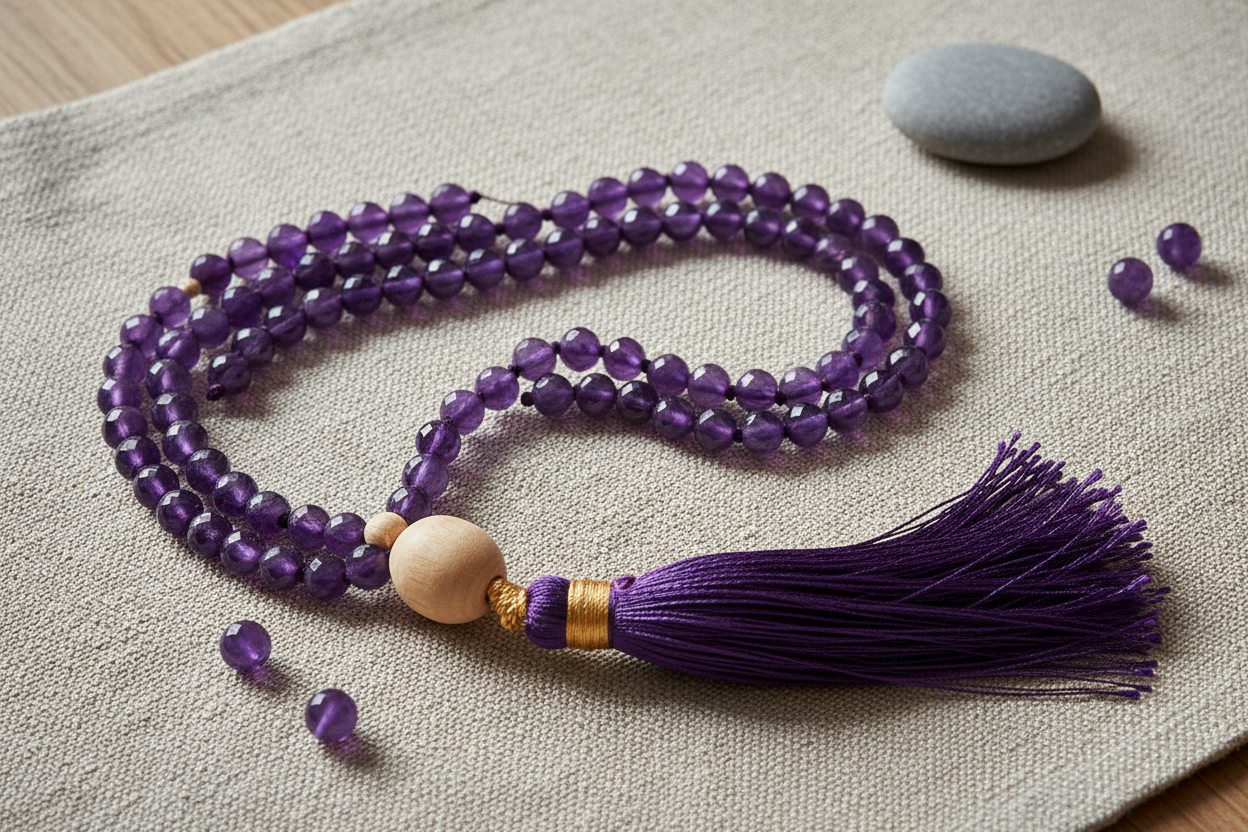
Additionally, there is the so-called Guru bead – a larger bead that marks the beginning and end of the strand. It represents the teacher, connection, and consciousness itself. When counting, upon reaching the guru bead, one turns back – it is never crossed.
When you meditate with a mala, you hold more than just beads in your hand — you hold thousands of years of accumulated wisdom.
What a mala carries is not random. Each material brings its own energy, its own story.
Rudraksha beads are considered the holiest among mala materials. In yogic tradition, they are seeds of the Rudraksha tree — closely associated with Shiva, the god of transformation. They ground, protect, and deepen meditation.
Gemstones like moonstone, rock crystal, or rose quartz are valued for their energetic properties. Moonstone strengthens intuition, rock crystal brings clarity, and rose quartz opens the heart.
Sandalwood beads have a natural scent that is calming, invites stillness, and simultaneously uplifts. In Indian tradition, sandalwood is considered a symbol of purity and connection to the Divine Mother.
At The Elephanthouse, we choose each material with awareness. Not just for the aesthetics — but because we believe that what you wear influences how you feel. Here is a selection of our Malas:
Whether one believes in the spiritual properties or not: The practice with the mala has measurable effects on well-being. Recent studies on the effects of mantra meditation confirm what practitioners have reported for thousands of years:
Stress reduction. The rhythmic, repetitive movement of the fingers on the beads activates the parasympathetic nervous system – the body's "rest-and-digest" system. Heart rate and breathing frequency decrease, cortisol levels drop.
Improved concentration. Japa meditation with the mala is a form of focused attention training. By synchronizing mind, breath, and movement, practitioners train their ability to direct attention.
Grounding and presence. The tactile experience – feeling each individual bead – anchors the meditator in the here and now. This sensomotor anchor is particularly helpful in times of anxiety or overwhelming thoughts.
Ritual framework. The mala creates a clear beginning and a clear end for the practice. This framework significantly lowers the entry barrier – you don't have to look at a clock, but simply follow the beads.
A question we often encounter: Can I wear a mala even if I don't have an active meditation practice? Can it just be beautiful?
Our answer: Yes. With all our hearts.
A mala is not an exclusive symbol for the initiated. It is an invitation — to every person who longs for more awareness, more stillness, more connection. Whether you wear it with an intention, a mantra, or simply because it touches you — all of that is right.
Many of our customers tell us that the mala reminds them of something every day. Of their yoga practice. Of an intention they have set. Of the stillness that waits within them. That is its true purpose — not perfection, but awareness.
○ Store it respectfully. Many people place their mala on a small cloth or in a box when they are not wearing it.
Above all: Trust your intuition. The mala will show you how it wants to be treated.
If you don't have a mala yet and these words resonate with you, then this might be your sign. Not because you need something — but because you are ready.
At The Elephanthouse, we handcraft each mala with love and deep intention. Each piece is unique — just like you. And we believe: The right mala finds you. Here you can find our selection. If you have any further questions or requests, feel free to contact us at any time.
The classic use of the mala is Japa meditation: You hold the mala in your right hand, starting at the guru bead — the larger bead that completes the necklace — and move with your thumb from bead to bead. At each bead, you quietly or internally repeat a mantra, a word, an intention, or simply your breath.
The guru bead itself is not crossed — it is the anchor, the beginning, and the end. When you reach it, turn the mala around and start again.
However, a mala does not necessarily have to be used for Japa meditation. Many people wear it as a daily reminder — of their intention, of their practice, of themselves. It can be a silent anchor for the heart, a powerful point of calm in everyday life or turbulent moments.
- Choose a quiet and undisturbed place where you feel comfortable. Center yourself for a few breaths.
- Choose a mantra or an intention (e.g., "So Ham" – I am that) or simply breathe consciously.
- Hold the necklace in your right hand between your thumb and middle finger – the index finger is traditionally left out.
- Start at the guru bead and move from bead to bead, repeating your mantra at each bead.
- After 108 beads, you will reach the guru bead – turn back if you wish to continue meditating.
- Conclude the practice with a moment of silence and a quiet thank you.
Today, the mala finds its place far beyond temples and ashrams: on the wrists of yogis, as a conscious accessory and reminder to be present in the here and now, as a powerful companion for your meditation practice. It is a millennia-old, proven, wonderful piece of jewelry that reminds us to pause and connect. Always. Everywhere. One bead at a time.